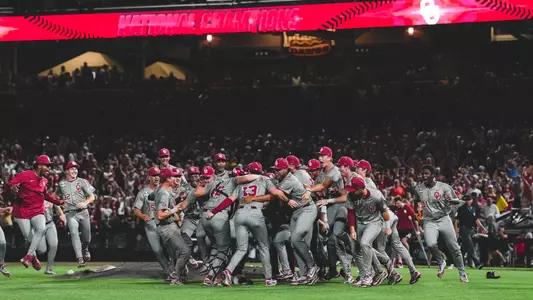
OMAHA, Neb. — By the time Oklahoma’s players started pouring out of the dugout Monday night, there was no need to check the scoreboard. The night had already turned into something bigger than a final score. Gloves went flying. Players sprinted toward the mound. Coaches grabbed one another before they could even decide whether to laugh, cry, or simply stare at what had just happened. In the stands, families leaned over railings and lifted phones into the air, trying to catch a moment that had taken 32 years for Oklahoma baseball to see again. The Sooners had beaten North Carolina 13-2 in the deciding game of the Men’s College World Series finals, and for the first time since 1994, they were national champions.
The easy way to tell the story is to say Oklahoma got hot at the right time. That is true, but it is also too neat. Nothing about this season had been neat. The Sooners spent their second year in the SEC getting pushed around by the best baseball league in the country, finishing 14-16 in conference play and carrying the kind of record that makes people wonder how much is really left in a team. They lost in the first round of the SEC Tournament. They were not some spotless powerhouse rolling through spring with a title already beginning to feel inevitable. They were good, uneven, talented, frustrating, dangerous, and searching. In other words, they were a college baseball team trying to survive long enough to become the version of themselves they kept talking about.
Then June arrived, and Oklahoma changed the way its season would be remembered. The Sooners went through the NCAA Tournament with a looseness that had not always been there earlier in the year. The lineup that had been good enough to scare people became deep enough to punish them. The pitching staff kept finding answers. The defense steadied the whole thing. By the time Oklahoma reached Omaha, the season no longer felt like a team trying to explain its flaws. It felt like a team that had made peace with them, learned from them, and stopped dragging them around.
That is what made Monday night so satisfying. Oklahoma did not win a championship because everything had gone right from the beginning. The Sooners won because enough things had gone wrong, and they were still standing. They had been tested by a conference schedule that did not offer many soft landings. They had been reminded that talent alone does not carry a team through June. They had been forced to grow up in public, and when they finally reached the last game of the college baseball season, they looked nothing like a group that had stumbled into the moment. They looked like a team that had been sharpened by every hard week it had lived through.
For Skip Johnson, the championship carried the weight of a career. Johnson has been in college baseball for more than three decades, long enough to know how rarely the sport gives anyone a perfect ending. Coaches spend their lives preparing players for games that can turn on a bad hop, a missed spot, a gust of wind, or one swing from someone nobody expected to be the hero. They work in repetition and patience. They teach confidence after failure. They ask players to believe in small adjustments that may not pay off until weeks later, if they pay off at all. On Monday night, after all those years, Johnson got to stand in the middle of the celebration and watch his players give him the ending every coach dreams about but few ever get.
The players seemed to understand that. Championship celebrations can be wild, but this one had a tenderness to it too. There was joy, of course, the loud and messy kind that belongs to college kids who have just won everything there is to win. But there was also a sense of release, especially around Johnson and the families who had followed this team all the way to Omaha. Oklahoma had been here before and fallen short. The Sooners had played for the national title in 2022 and watched someone else celebrate. The program had carried the memory of 1994 for so long that it had become less of a recent history point and more of a story passed down. Most of the players on this team were born long after that last title. On Monday, they made a new memory for everyone else to chase.
No player gave this run a more human face than Jaxon Willits. The freshman shortstop was named the Most Outstanding Player of the College World Series after a brilliant week at the plate, but numbers only tell part of why his story landed. Willits is the son of Reggie Willits, the former major leaguer who now works on Oklahoma’s staff. He is also a young father himself. So while he was playing the best baseball of his college life, he was doing it with his dad nearby and his daughter in the stands, during a week when Father’s Day already had a way of making every family connection feel a little closer to the surface.
That is the kind of detail that keeps college sports from feeling like a business transaction. It is one thing to say a freshman had a great tournament. It is another to picture him standing in Omaha with three generations of meaning wrapped around the week: the father who helped raise him in the game, the son trying to make his own name in it, and the little girl who may one day only understand the night through pictures and stories. Willits did not just become a star in Omaha. He became part of one of those family snapshots that college baseball seems especially good at producing, the kind where the game is only the setting and the people are the story.
Oklahoma had another one of those moments before the finals even began. In the Sooners’ win over Georgia, Kyle Branch started for Oklahoma while his older brother, Kolby, started for the Bulldogs. Two brothers, opposite dugouts, both trying to get their team to the final series in Omaha. Kolby homered late in the game, and Kyle, even while playing for the team that ended his brother’s college season, met him with a high-five on the field. Afterward, the brothers embraced, and the moment belonged as much to their parents as it did to either dugout. That is the beautiful contradiction of this tournament. One dream keeps going only because another one ends, and sometimes both dreams grew up in the same house.
By Monday night, those smaller stories had gathered into one larger one. Oklahoma’s championship was not just about a program returning to the top of college baseball. It was about the strange, emotional math of a team sport, where a title belongs to everyone and still somehow means something different to each person holding it. For Johnson, it was the payoff after decades in the game. For Willits, it was a first Omaha trip that became family history. For Branch, it was the end of a week that included beating his brother’s team and then winning a national title. For the seniors, it was the last ride turning into the best one. For the parents, it was proof that all those weekends and miles and nervous innings had led somewhere real.
North Carolina, to its credit, had its own story and its own heartbreak. The Tar Heels forced the championship series to a third game and once again brought a strong team to Omaha, but the program’s long wait for a first baseball national title will continue. That part should not be ignored, because feel-good stories in sports almost always come with someone else walking off quietly. UNC had earned the right to believe Monday could be its night. Oklahoma simply took the game away before that belief could fully breathe.
The Sooners scored early, kept adding on, and eventually turned the most stressful kind of baseball game into a celebration waiting for permission to start. Kyle Branch delivered one of the biggest swings, a late three-run homer that pushed the night fully into Oklahoma’s hands. L.J. Mercurius gave the Sooners the kind of steady outing every team wants in a winner-take-all game, and the lineup kept applying pressure until North Carolina had used arm after arm trying to stop it. The 13-2 score was not a fluke or a weird bounce. It was Oklahoma playing its cleanest, freest baseball at the exact time a team dreams of doing so.
Still, when people remember this title years from now, they may not start with the box score. They may remember the way Johnson looked when the wait was finally over. They may remember Willits, barely into his college career, already carrying a story most players never get. They may remember the Branch brothers sharing a moment in the middle of competition, a reminder that the game can be ruthless and gentle in the same inning. They may remember a team that went 14-16 in its league and still found a way to become the last one standing.
That is why this Oklahoma title feels good. Not because it was perfect. Because it was not. The Sooners had to live through enough doubt for the ending to feel earned. They had to let the season make them tougher without making them bitter. They had to keep showing up after the weeks that made a national championship look far away. And when the chance finally came, they did not tiptoe into it. They grabbed it, ran with it, and turned the final night in Omaha into the kind of memory that makes every hard part look different in hindsight.
When the celebration slowed, the field still held the feeling of a place nobody wanted to leave. Players hugged parents. Coaches posed for pictures. Teammates kept drifting back toward each other, as if separating too soon might break the spell. Somewhere in all of that noise was the simple truth of the night: Oklahoma had waited a long time for this, and maybe that wait was part of what made it beautiful.
The Sooners did not just win a title Monday.
They gave their coach his moment, gave their families a summer they will talk about forever, and gave college baseball the kind of story it does best: imperfect, emotional, a little messy, and absolutely worth the wait.