
He is nineteen. He has never known a silent room; there has always been a screen glowing somewhere, a feed to fall into, a thousand voices a thumb-swipe away. And he has never in his life felt so alone. This is the generation raised more connected than any before it, and lonelier than any we have ever measured. Everyone knew how their story ended. They would be the ones who finally let the old rooms go dark, the churches and the clubs and the town squares, trading all of it for the blue light of a phone.

FeatureThe Sideline Newsroom
The Great American Revival
He has four hundred friends and no one to call.
Young worshippers gather for a candlelight service.By Thomas Harden
8 min read
Share

Instead, quietly, in more places than anyone expected, they are standing up, putting the phone down, and walking back in.
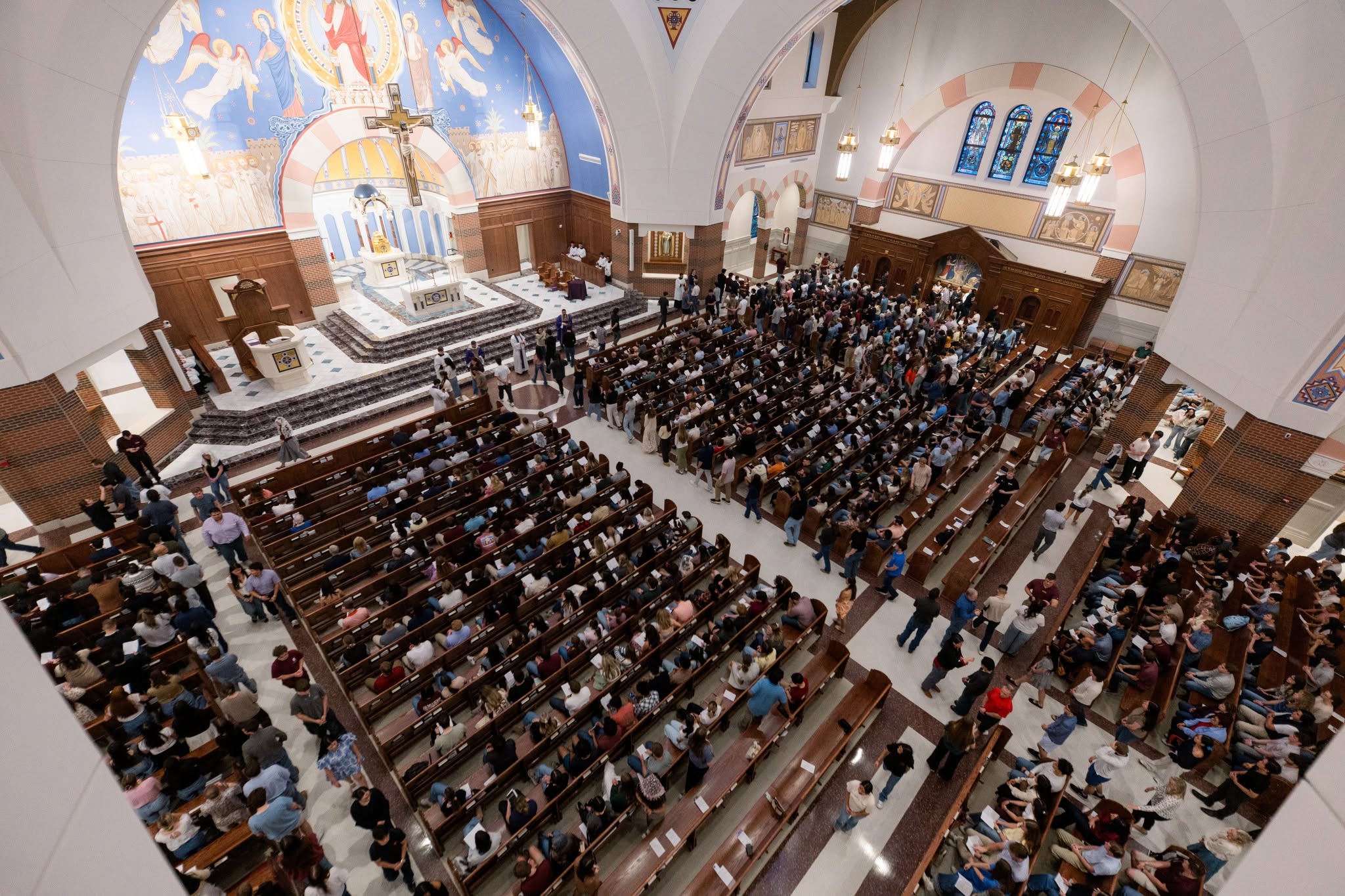
College Station, Texas“The pews fill, then the side aisles fill.”
Students fill St. Mary's Catholic Center in College Station, Texas.St. Mary's Catholic Center
On a Sunday morning at St. Mary's in College Station, you can watch it happen in real time. The pews fill, then the side aisles fill, young people lined shoulder to shoulder along the walls, and the ones who came last hover near the open doors, listening from the threshold. The church seats over fifteen hundred. It is the third one they have built on that ground in a century, each bigger than the last, because the students keep outgrowing them. Look out over that crowd and the thing that catches in your chest is not how many there are. It is how young they are. Nineteen, twenty, twenty-two, almost every one of them, packed into a building their grandparents' generation was supposed to have emptied for good.
For years we were told these were the kids who would close the church down. The least religious generation ever counted, raised online, allergic to tradition, done with all of it. Somebody forgot to tell them. They keep showing up, more of them every year, and not only in Texas. They are packing arenas in Oklahoma and getting baptized in horse troughs in Ohio, filling parishes from Portland to Boston, lining up in the heart of Manhattan where churches turn away crowds who drove in from other states just for a seat. It is happening everywhere at once, in places that share nothing but the age of the faces.

The room fills back up
At Ohio State, football players spent a season calling it the "Jesus Won" year, and one night hundreds of students were baptized on campus in tubs the players hauled in themselves, teammates dunking teammates while the crowd wept. In stadium after stadium, a movement called Unite US has filled arenas with students who came to worship, ten thousand at Texas A&M's Reed Arena, nine thousand at Oklahoma, eight thousand at Kentucky, with kids lined up afterward to be baptized in horse troughs and truck beds hauled onto the lawn. These are not the children of the faithful being marched to church. They are the curious, the skeptical, the along-for-the-ride, walking in on a whim and walking out changed.
And it is not just the loud, electric nights. It is the quiet paperwork of conversion, too, in churches of every kind, and it is rising everywhere at once. Catholic dioceses that spent decades watching the numbers fall are suddenly recording adults asking to be baptized at levels not seen in a generation. Portland went from 700 in one recent year to 1,700. Boston nearly tripled its usual class. Cleveland more than doubled. Oklahoma City, Los Angeles, Duluth, all up by half or far more. Protestant and evangelical churches are seeing the same doors swing open. Red states and blue, coasts and cornfields, the same graph bending the same hopeful way.
The dry numbers agree. Every forecast had this generation finishing off American religion; instead they walked back in. The typical young churchgoer now shows up nearly twice a month, more often than their own grandparents. The long tide of the "nones," the ones who checked no box at all, has finally stopped rising. And for the first time in the modern era, it is young men leading the way, the very ones nobody could ever drag to church, now the most likely of anyone their age to be in the pew on a Sunday morning. Something in them went looking, and it was not looking for a screen.
This is not the whole country turning at once, and it does not have to be. A fire does not need to consume the whole forest to be real. You only have to stand near it to feel the heat, and near these rooms, the heat is unmistakable. Something has caught, and it is spreading.
And it is not only America. Cross an ocean to France, the country that once taught the world how to leave God behind, where the great cathedrals had become museums full of tourists and empty of believers. This past Easter those old churches filled with young adults asking to be baptized, more than in any year on record, and for the first time the largest group coming forward were under twenty-five, kids who were never raised in the faith choosing it cold, and choosing it anyway. If it can happen there, in the birthplace of the modern secular world, it can happen anywhere. And it is.
The village that went viral
Even New York City. In deep-blue Manhattan, a Greenwich Village church called St. Joseph's has watched its Sunday crowd swell to three and four times its old size, a line running out the door every week. A pre-Mass meetup called "Pizza to Pews" pulled a hundred young adults its first weeks and two hundred by its third, and today it draws people from as far as Boston. For pizza and a pew.
Nobody organized this. It moved the way everything moves now, through a phone. A young New Yorker started ranking the city's churches on TikTok, and the crowds followed the rankings. A 23-year-old launched a "Holy Girl Walk" in Central Park; fifty women came the first time, and after a video of them praying went online it swelled past a hundred and fifty. The same platforms blamed for stealing this generation's attention were quietly handing it back, and pointing it toward a pew.
That is the shape of it everywhere, across every kind of church. Evangelical campus ministries are baptizing more students than they have in decades. Young people are pouring into Catholic parishes, Pentecostal congregations, Protestant chapels and packed nondenominational auditoriums alike. After years of freefall, the share of Gen Z calling itself Christian is climbing again.
What they were running from
The answer is simple, and it is the same everywhere. This generation was handed a phone and told it was the whole world. What it turned out to be was a machine built to sell them things. It learned that anger holds attention longer than joy, so it fed them anger. It learned that they would click on a fight, so it started fights. It showed them ads they did not ask for and strangers they were taught to hate, because the hate kept them scrolling. More than four in ten of them have been diagnosed with a mental health condition. None of it was an accident.
And then the strangest part. Half of it was never real. For the first time in the history of the internet, the bots outnumber the people. More than half of all web traffic is now machines. The account picking a fight with you might be a program. The outrage everyone is sharing might be manufactured. A generation went looking for other people and found a room full of ads and phantoms, all of it engineered to keep them clicking and keep them apart. So the boy with four hundred friends and no one to call went looking for something real. And a whole generation was looking for the same thing at the same time. A real room, full of real people
Here is what they found.
Not a doctrine, at least not first. A room. Real people in it, close enough to touch. The person in the next seat who is actually there. A shared meal, a hand on your shoulder, a few hundred voices saying the same words at the same time until the walls seem to hum with it. Picture him walking in for the first time. Nobody is selling him anything. Nobody is arguing. A stranger turns, puts out a hand, and knows his name by the end of the hour. He came looking for something to believe and found something rarer still. He found somewhere he is missed when he does not show up.
That is the thing a screen can never give and a room always can, and this generation has figured it out faster than anyone thought they would. It spreads the way good news always spreads, one person leaning over to tell another there is a seat. In College Station and Columbus, in Manhattan and Oklahoma and a thousand towns whose names you will never learn, the same quiet, hopeful decision, made one young person at a time.
They were told they would be the generation that let all of this die. Instead they are the ones carrying it back inside. Call it a revival, call it a homecoming, call it a generation putting the phone down and looking up and finding each other waiting there. Whatever you call it, it is real, it is spreading, and it is only just beginning.
Advertisement