
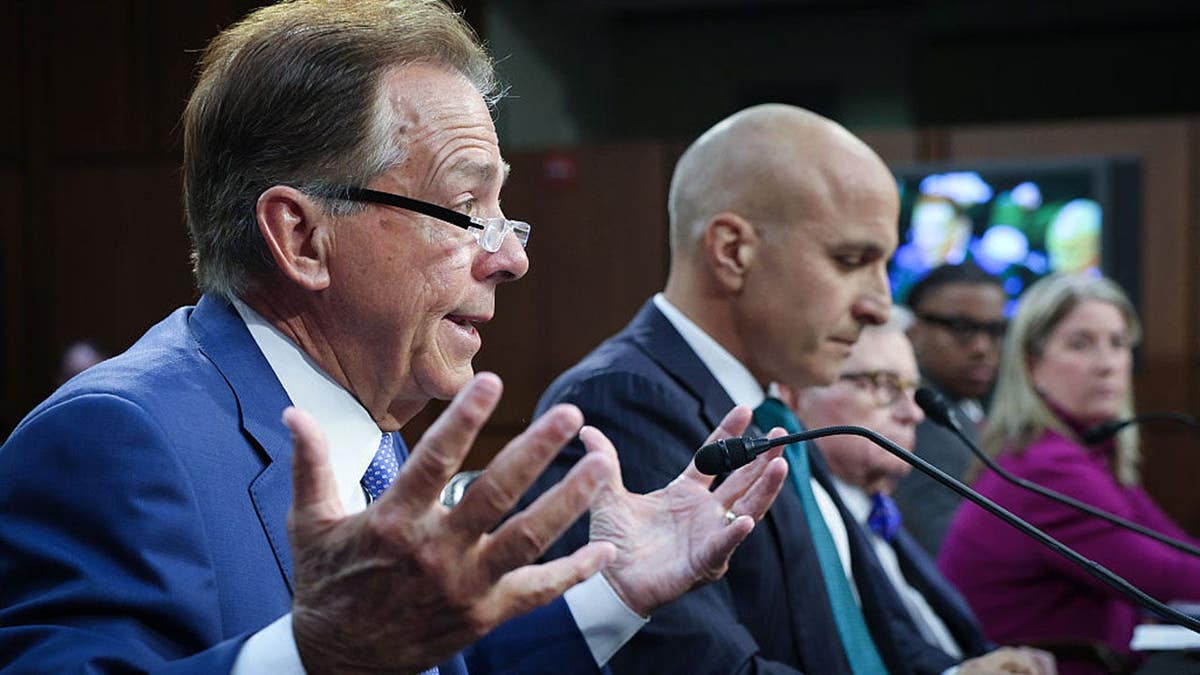
WASHINGTON — Nick Saban has not coached a game since December 2024. On Wednesday, standing at a Senate microphone in front of the Commerce Committee, he looked like he had never stopped.
Eleven minutes. That is how long his opening statement lasted. In those eleven minutes, he named Brendan Sorsby by name in the United States Senate, compared the state of college sports to a Ferrari going 150 miles per hour toward the Grand Canyon, accused NIL collectives of disguising pay for play as marketing deals, and said plainly that the sport has become an arms race where the team that spends most has the best chance to win and that it is "a race to the bottom."
He was not wrong. According to The Sideline's NIL Tracker, updated this week at https://thesideline.co/nil-tracker, total spending across all 357 Division I programs has reached $3.4 billion for the 2026 season. Texas leads every program in the country at $74 million. LSU, the program Lane Kiffin took over from Ole Miss in December and immediately rebuilt with what CBS Sports reported is somewhere between $40 and $60 million in roster spending alone, sits second nationally at $66 million. Ohio State is third at $64 million. Oregon fourth at $60 million. Texas A&M fifth at $57 million. The Power Four programs account for $2.2 billion of that $3.4 billion total. The six-figure programs at the bottom of the list are competing for the same national championship as the programs at the top. They are not getting close.
Saban's most pointed moment came when he addressed Sorsby directly. "An example would be Ole Miss' quarterback," he told the senators, using Sorsby as evidence that the current litigation-driven system has made rules functionally unenforceable. "They said he can't play next year. But he's playing because of litigation. This is just the way it is."
He returned to the Ferrari. "It's become an arms race," he said. "Who spends the most has got the best chance to win. But I think it's a race to the bottom, because if you don't spend to win, you lose your fan base and you don't have any revenue."
The hearing was called to examine the Protect College Sports Act, the bipartisan bill introduced last week by Senators Ted Cruz and Maria Cantwell. Joining Saban at the witness table were Pac-12 Commissioner Teresa Gould, West Virginia University President Gordon Gee, Notre Dame athletic director Pete Bevacqua, and Utah football player Lance Holtzclaw. For nearly three hours, the committee heard testimony about a system almost everyone in the room agreed was broken. The split was not over the diagnosis. It was over the cure.
Kiffin, whose move from Ole Miss to LSU senators specifically cited as an example of the mid-season coaching chaos the bill is meant to prevent, watched from Baton Rouge. His LSU program sits second on The Sideline's tracker at $66 million, a number that includes Sam Leavitt's quarterback deal believed to be in the $5 million range, the No. 1 ranked transfer class in the country by On3, and the $13 million annual salary the Tigers are paying Kiffin himself before incentives. Between the coach, the roster, and the assistant salary pool, LSU may be spending more than any single program in the history of college football.
Tennessee at $50 million. Alabama at $49 million. Georgia at $48 million. Miami at $55 million. Notre Dame at $52 million. These are the programs competing for the same playoff spots, the same five-star recruits, the same portal quarterbacks, against a cap that was supposed to be $20.5 million and has become a floor that every program in the country immediately built on top of.
The most striking moment of the hearing was what was missing from the room. The Big Ten and SEC, the two conferences whose programs occupy nine of the top ten spots on The Sideline's NIL spending list, issued a joint statement opposing the bill. They said it "leaves critical issues unresolved." Cruz told the Associated Press afterward that he remains confident. "We're going to get the votes," he said. "If we do nothing, there is no alternative. As every witness testified, college sports is facing a crisis."
More than 40 college sports bills have been introduced in Congress since 2020. Not one has passed. The earliest the Protect College Sports Act could reach the Senate floor is the end of July. Congress takes a month-long recess after that. College football's season starts in late August.
Three point four billion dollars. That is what Division I programs are spending on their rosters this year. Texas alone is spending $74 million. The $20.5 million cap that was supposed to govern all of this is a suggestion that the sport stopped following before the ink was dry.
Nick Saban flew to Washington and told the Senate that somebody needs to tap the brakes. The Ferrari is still going 150 miles an hour.